

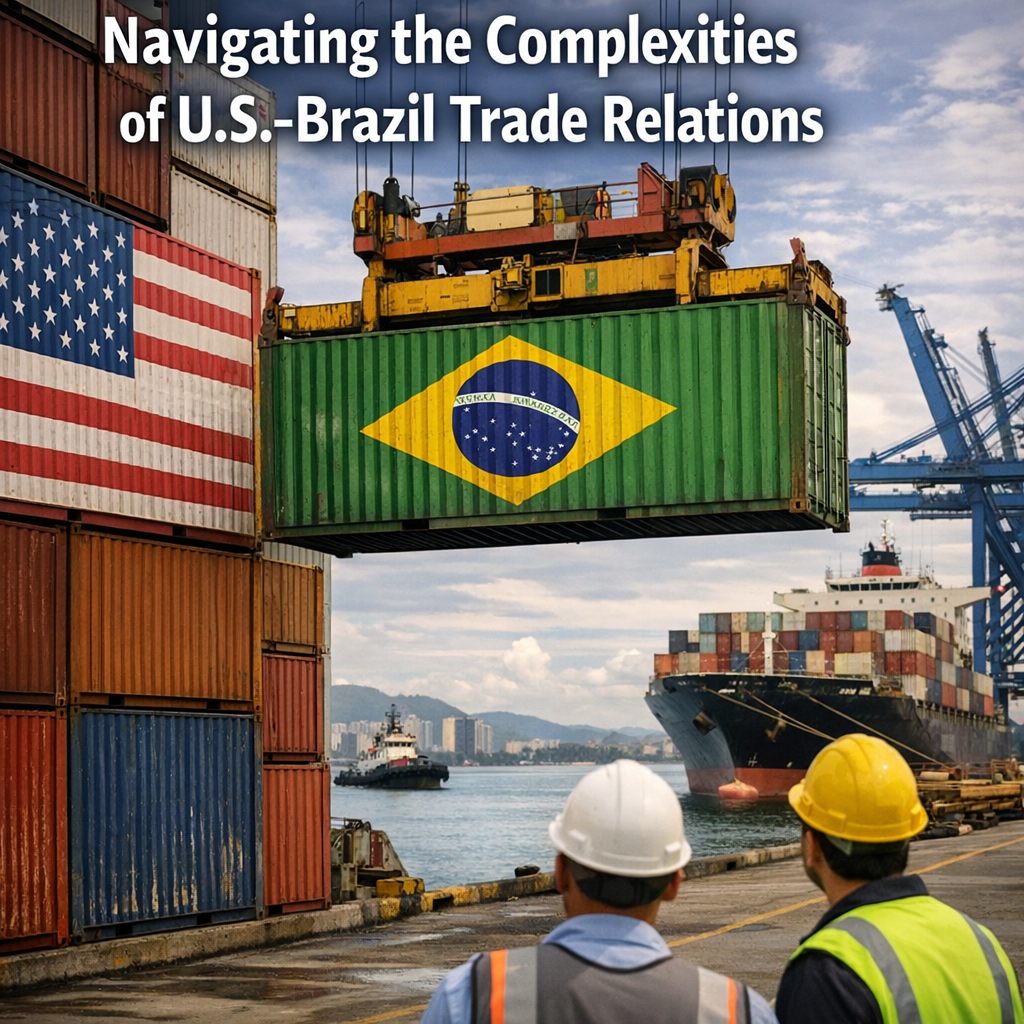
The trade relationship between the United States and Brazil has long been a cornerstone of economic interaction in the Western Hemisphere. As the two largest economies in the region, their bilateral trade has experienced both growth and challenges, reflecting the complexities inherent in international commerce.
Historical Context and Recent Developments
Historically, the U.S. has maintained a trade surplus with Brazil. In 2024, U.S. goods exports to Brazil were valued at $49.1 billion, marking a 10.3% increase from the previous year. Conversely, U.S. goods imports from Brazil totaled $42.3 billion, up 8.4% from 2023. This resulted in a U.S. goods trade surplus of $6.8 billion in 2024, a 23.9% increase over 2023. The services sector also saw significant activity, with U.S. services exports to Brazil reaching $29.6 billion in 2024, up 24.4% from 2023. U.S. services imports from Brazil were $6.5 billion, leading to a services trade surplus of $23.1 billion in 2024, a 31.9% increase from the previous year.
However, recent policy changes have introduced new dynamics. In April 2025, the U.S. imposed a 10% tariff on Brazilian imports, followed by an additional 40% tariff in July 2025. These measures led to a significant decline in U.S. imports of Brazilian products, particularly in sectors where Brazil was a key supplier, such as coffee, orange juice, and meats. By November 2025, exemptions were granted for certain goods, leading to a partial recovery in imports.
Sector-Specific Impacts
The agricultural sector has been notably affected. For instance, U.S. imports of Brazilian coffee dropped to around 17,000 tons in September 2025, when effective tariffs reached 46.5%, but rebounded to approximately 21,500 tons in December after the reduction of tariffs. Despite this recovery, these figures remain below the monthly average of over 38,000 tons observed from January 2024 to March 2025.
In the ethanol industry, both countries have historically been major producers. The U.S. and Brazil enjoyed duty-free ethanol trade for much of the 2010s. However, in 2017, Brazil reinstated a 20% tariff on U.S. ethanol imports, leading to trade frictions that persist today.
Looking Ahead
Despite these challenges, the U.S. and Brazil continue to seek avenues for cooperation. The Agreement on Trade and Economic Cooperation (ATEC), established in 2011 and expanded in 2020, serves as a platform for addressing bilateral trade and investment issues. The 2020 Protocol, which includes annexes on Trade Facilitation and Customs Administration, Good Regulatory Practices, and Anti-Corruption, entered into force in 2022, aiming to enhance transparency and efficiency in trade relations.
As both nations navigate these complexities, ongoing dialogue and negotiation will be crucial in fostering a mutually beneficial trade relationship that supports economic growth and stability in both countries.