

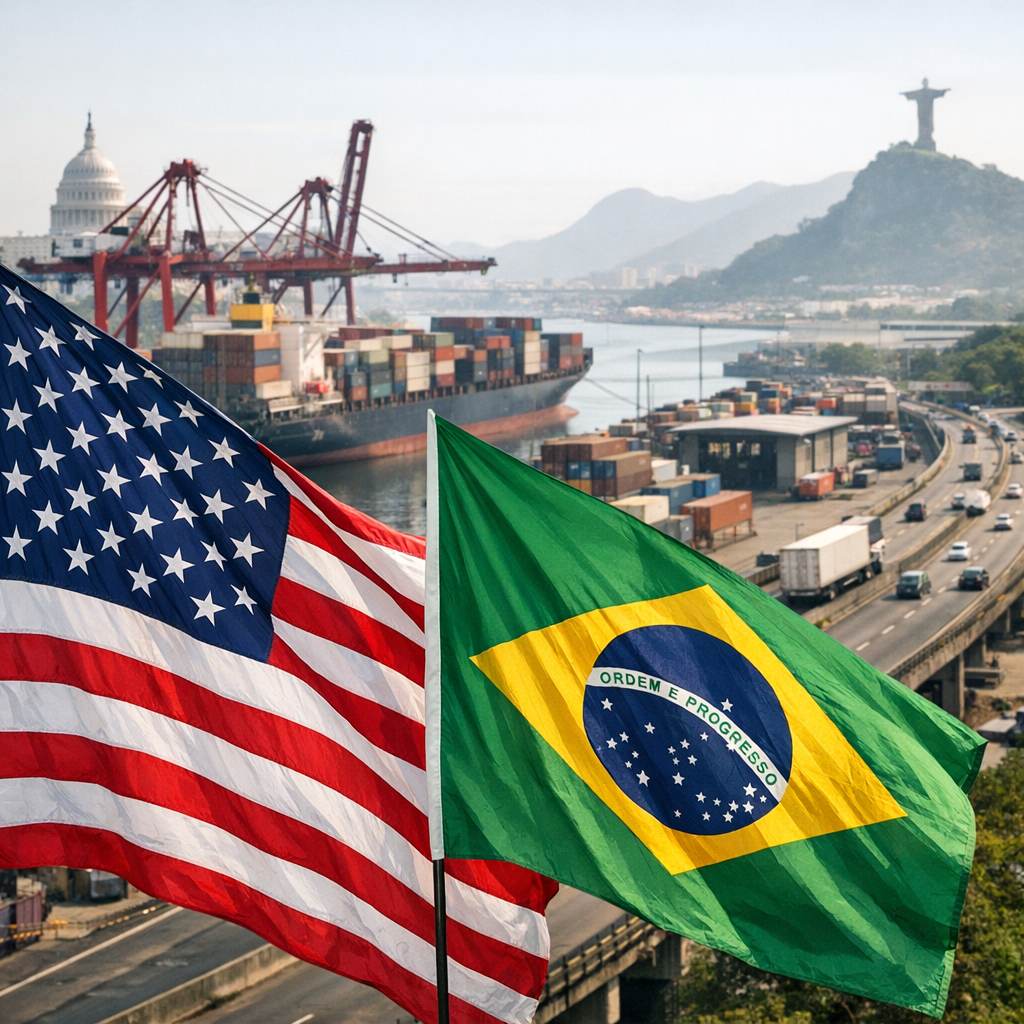
The trade relationship between the United States and Brazil has long been a cornerstone of both nations’ economies. As the two largest economies in the Western Hemisphere, their economic interactions have significant implications for global trade patterns.
Historical Context
Since the United States recognized Brazil’s independence in 1824, the two countries have maintained robust political and economic ties. Over the decades, this relationship has evolved, encompassing various sectors and adapting to global economic shifts.
Recent Trade Dynamics
In recent years, the trade balance between the U.S. and Brazil has experienced notable changes. In 2024, U.S. goods exports to Brazil were valued at $49.1 billion, marking a 10.3% increase from the previous year. Conversely, U.S. goods imports from Brazil totaled $42.3 billion, up 8.4% from 2023. This resulted in a U.S. goods trade surplus of $6.8 billion in 2024, a 23.9% increase over 2023. The services sector also saw growth, with U.S. services exports to Brazil reaching $29.6 billion in 2024, up 24.4% from 2023. U.S. services imports from Brazil were $6.5 billion, leading to a services trade surplus of $23.1 billion in 2024, a 31.9% increase from the previous year.
Key Sectors and Products
Several sectors have been pivotal in the U.S.-Brazil trade relationship. Notably, U.S. exports to Brazil in 2024 included significant amounts of dairy products ($113.22 million), essential oils ($102.68 million), and other intermediate products ($102.43 million).
Challenges and Opportunities
Despite the strong trade ties, challenges persist. For instance, the U.S. has kept ethanol, chemicals, and recycled PET on Brazil’s trade friction list, indicating ongoing disputes in these areas.
However, both nations have opportunities to strengthen their economic partnership. The Agreement on Trade and Economic Cooperation (ATEC), established in 2011 and expanded in 2020, provides a framework for addressing trade issues and enhancing bilateral relations.
Conclusion
The U.S.-Brazil trade relationship is multifaceted, characterized by both longstanding cooperation and emerging challenges. As global economic landscapes shift, both nations must navigate these complexities to foster mutual growth and prosperity.